
I’ve spent more than 30 years leading teams, and one thing I’ve learned is that productivity is rarely just about how hard people work. It’s about the environment we create around them, and that’s especially true when it comes to remote team productivity.
When people have clarity about what matters, understand how their work contributes to the bigger picture, feel trusted to make decisions, and have the space to get their work done, productivity becomes a whole lot easier.
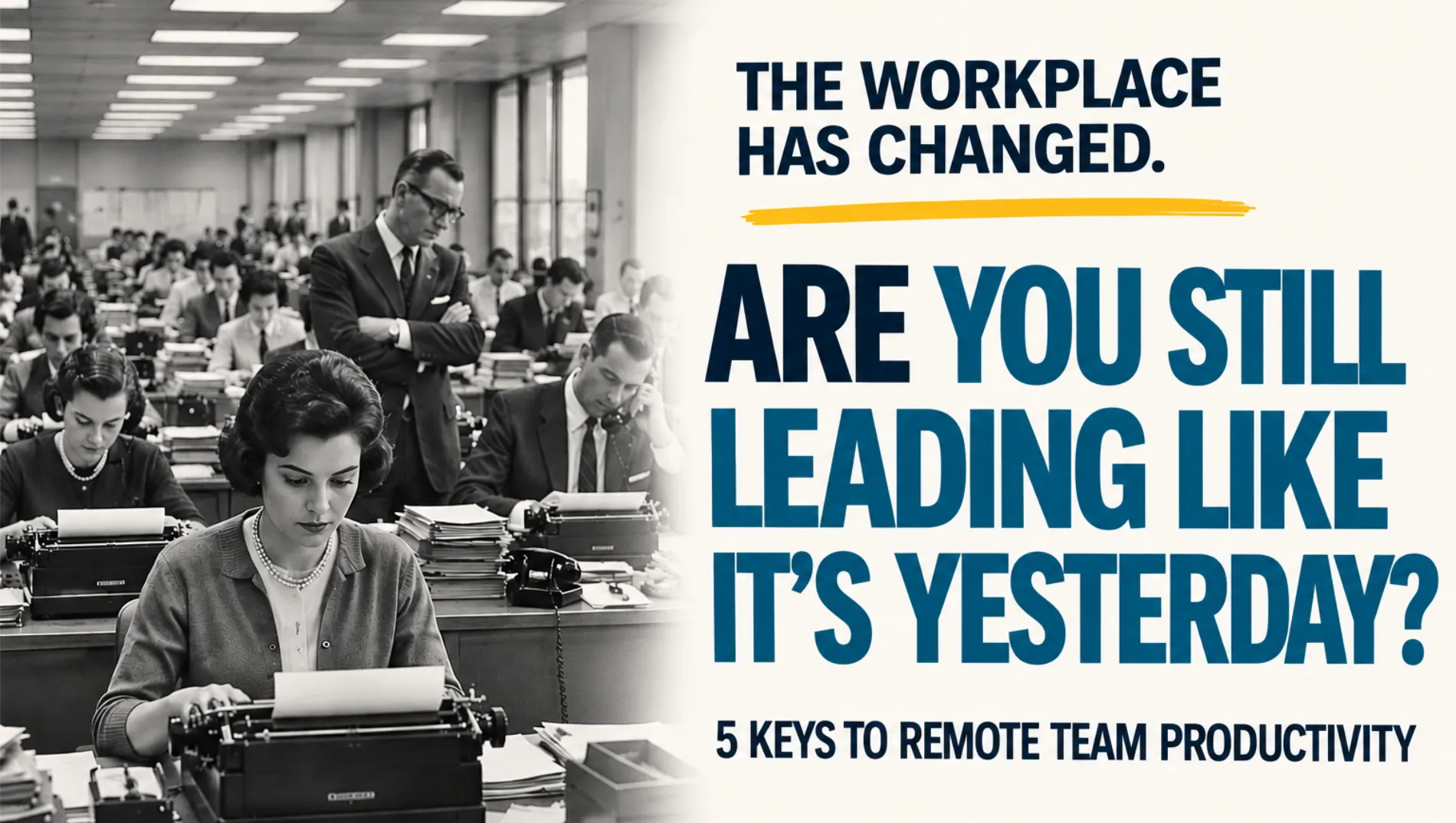
But here’s a question I often ask leaders during my keynotes: Our employees are working in a very different environment today. Are we still leading from a model that was built for a different time?
For decades, management practices developed around people working together in the same physical space. We could walk down the hall to clarify something, gather around a table to solve a problem, or notice when someone needed help. Those informal opportunities are different when people work remotely.
The fundamentals of good leadership haven’t changed. People still need clarity, connection, trust, accountability, and purpose. What’s changed is how intentionally we need to create those conditions.
Research gives us good reason to pay attention. Gallup has documented challenges with clarity of expectations at work, while Microsoft’s 2025 Work Trend Index describes the fragmentation of the modern workday. Neither finding means remote work is inherently less productive. Both raise questions about how work is organized and led.
Productivity isn’t something we can simply demand from our teams. It’s something we have to create the conditions for.
In The Remote Leadership Lab, we spend a lot of time exploring what actually makes remote teams productive. Not just the tools and technology they use, but the leadership practices and working conditions that allow people to do their best work.
And one thing becomes increasingly clear: Productivity isn’t simply about how hard people work. It’s about how effectively we create the conditions for them to succeed.
So, what does that look like in practice?
Let’s explore five of the most important drivers of remote team productivity, what the research tells us, and what leaders can do to make a meaningful difference.
1. Strategic clarity and aligned goals: Agree on the route, not just the destination
One of the biggest misconceptions about productivity is that when everyone understands the company’s goals, they’re naturally working toward the same outcomes. Unfortunately, it’s not that simple.
Imagine a company where leadership has established a clear objective: increase revenue by 15% over the next 12 months. Marketing sees the biggest opportunity in attracting new customers, so it invests in lead generation. Sales believes the fastest path is expanding existing accounts. Product believes future growth depends on entering a new market, so it develops features for a different customer segment.
Everyone knows the target. Everyone is working hard. Everyone believes they’re contributing. But they’re taking three different routes, and those routes aren’t necessarily complementary. Marketing might attract prospects for offerings the company isn’t prioritizing. Sales might identify expansion opportunities that product isn’t supporting. Product might spend months building capabilities that won’t contribute to near-term growth.
Now imagine leadership translates that same 15% target into a shared strategy: grow revenue within the existing target market. Marketing focuses on qualified prospects in that market and relevant expansion campaigns. Sales shares customer objections and identifies the best opportunities. Product prioritizes improvements that address those needs. Each team has different responsibilities, but the decisions connect.
That’s the difference between having a team of busy people and having a team that’s moving in the same direction.
This is a hypothetical example, but the alignment challenge is real. Research published in MIT Sloan Management Review reported that only 28% of executives responsible for executing strategy could correctly identify three of their company’s strategic priorities. A separate Harvard Business Review study of nearly 8,000 managers across more than 250 companies found that only 9% said they could rely on colleagues in other functions and units all the time. These studies highlight different problems—understanding strategy and coordinating across functions—but both matter for execution.
For anyone leading remote teams, the lesson is simple: don’t assume that announcing the goal creates alignment. Explain the strategic choices behind it, how departments contribute, and what trade-offs teams should make when priorities compete.
2. Visible workflows: Make the work—and the handoffs—clear
Clarity about the strategy is only the beginning. People also need to see how the work moves: what is underway, who owns each deliverable, what comes next, and where a dependency could hold someone up.
Consider a client launch. Sales has promised a date, product is waiting on final requirements, and marketing is preparing an announcement. If those dependencies live in separate inboxes and meetings, a missed handoff may stay invisible until it becomes urgent. A shared launch plan with owners, milestones, decisions, and risks gives everyone a common view. The point isn’t to create more reporting; it’s to reduce the detective work required to collaborate, which can quietly drain remote team productivity.
The Harvard Business Review strategy-execution research emphasizes the difficulty of coordination across functions. Visibility is one practical response to that challenge, not a guarantee of better results.
For leaders, a useful question is: Can a teammate quickly tell what matters this week, who is responsible, and where they need to coordinate—without scheduling another meeting?
3. Focused execution: Protect time to turn priorities into progress
Even the clearest plan won’t deliver results if the workday is sliced into dozens of interruptions. Remote work can give people flexibility, but a full calendar and constant messaging can leave very little room for the work that requires sustained attention.
Microsoft’s 2025 Work Trend Index reported that the most heavily interrupted 20% of Microsoft 365 users received an average of 275 meeting invitations, emails, and chat notifications per day. That figure describes a high-notification subgroup—not the average employee—but it illustrates how intense digital interruption can become.
Imagine an analyst who needs two uninterrupted hours to prepare a client recommendation. If every question becomes an instant message and every update becomes a meeting, the analysis keeps getting pushed aside. A team can instead agree on response-time expectations, use asynchronous updates for routine information, and reserve protected blocks for complex work.
Focused execution is not about asking people to squeeze more into every hour. It’s about removing the friction that prevents important work from getting done, which matters even more when your team works remotely.
4. Trust and psychological safety: Make it safe to speak up and own the work
A remote leader can’t see every moment of the workday—and shouldn’t need to. Trust means setting clear expectations, giving people room to deliver, and being available when support or decisions are needed. Psychological safety adds another essential ingredient: people need to be able to ask questions, admit mistakes, and challenge assumptions without fear of embarrassment.
Google’s Project Aristotle research identified psychological safety as the most important dynamic in the effective teams it studied. That doesn’t mean every team will improve simply by being nicer to one another. It means the quality of interpersonal interactions deserves serious leadership attention.
Picture a remote employee who spots a flaw in a launch plan. On one team, they stay quiet because previous concerns were dismissed or critiqued. On another, they raise the issue early, and the team corrects course. The second team hasn’t eliminated mistakes; it has created a better chance of catching them before they grow.
Leaders can reinforce this by inviting dissenting views, acknowledging their own uncertainties, and responding constructively when someone brings forward bad news. On remote teams, trust and accountability are partners, not opposites.
5. Manageable workload and sustainable work design: Build productivity that lasts
We sometimes talk about productivity as though the answer is always to do more. But when every request is urgent, every project is a priority, and everyone is expected to be constantly available, the system itself can become the obstacle.
The World Health Organization describes burnout as an occupational phenomenon resulting from chronic workplace stress that has not been successfully managed. Its definition includes exhaustion, increased mental distance or cynicism about work, and reduced professional efficacy. Burnout is not classified by WHO as a medical condition.
Imagine a team that is consistently meeting deadlines only because people work evenings and weekends. On paper, performance may look strong. But that pace leaves little margin for unexpected demands and can put long-term sustainability at risk. A better design starts with realistic capacity, explicit priorities, fewer simultaneous commitments, and permission to disconnect when the workday is over.
This is where manageable workload, protected focus, and sustainable work design come together. Leaders of remote and hybrid teams need to ask not only, ‘Can we deliver this?’ but also, ‘Can we keep delivering this way?’
The leadership shift behind remote team productivity
The five drivers reinforce one another. Strategy gives people direction. Visible workflows connect the work. Focus creates room to execute. Trust makes it easier to surface problems and make decisions. Sustainable work design keeps the system functioning over time.
And none of this requires leaders to abandon the fundamentals of good leadership. It requires us to be more deliberate about how those fundamentals show up when our teams aren’t sharing the same office.
We’ve changed the way our people work. The question is, have we changed the way we lead?
Remote team productivity isn’t about finding new ways to supervise people we can no longer see. It’s about creating the conditions that allow them to do their best work.
Wondering where your team could use more clarity, focus, trust, or support? Our remote leadership training gives leaders practical tools to create the conditions where people can work effectively, stay connected, and deliver results—wherever they’re working. Let’s Talk About Your Team.